Movies
CSMB Image Movie: https://csmb.hu-berlin.de/wp-content/uploads/2026/04/260227_new-title_IMAGE_FILM_FINAL_H264_2.mp4 CSMB Master Class: https://csmb.hu-berlin.de/wp-content/uploads/2026/04/260224_NEW-VERSION_MASTERSTUDIENGANG_2.mp4
The FAIRmat consortium of the National Research Data Infrastructure (NFDI) has developed a new web-based application, the Catalysis App, for managing standardized experimental catalysis data. This work is now reported in the journal Nature Catalysis. The Catalysis App allows researchers to share, explore, and analyze data and provides a foundation for artificial-intelligence-driven discovery of more
NOMAD Catalysis App Read More »
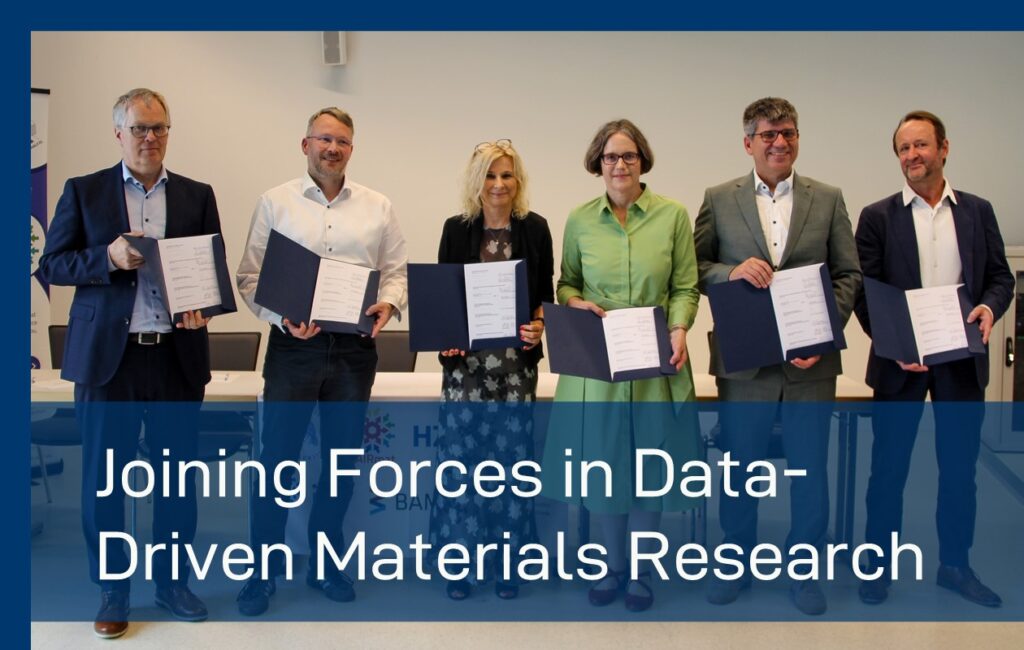
L.t.r.: Prof. Bernd Rech, Prof. Julia von Blumenthal, Dr. Ina Czyborra, Prof. Philipp Adelhelm, Prof. Ulrich Panne, Saskia Vormfelde, Dr. Tim Fellinger, Prof. Yan Lu. © BAM The Federal Institute for Materials Research and Testing (BAM), the Helmholtz-Zentrum Berlin (HZB) and Humboldt-Universität zu Berlin (HU) officially inaugurated the Berlin Battery Lab (BBL) on 19 March.
Researchers at Humboldt-Universität zu Berlin develop molecular photoswitches that use light to adjust mechanical strain, enabling on-demand control of chemical reactions.Graphic (molecule and clamps) by First Author Tom Bösking (modified) Controlling exactly when and where chemical reactions take place remains one of the central challenges in modern chemistry. Heat, mixing, or catalysts typically affect entire
Nikolai Severin, Filippo Giovanni Fabozzi, and colleagues investigated the supramolecular organization of Y6 – a widely used non-fullerene acceptor in organic solar cells – and found that co-deposition with small donor molecules leads to formation of a series of donor–acceptor two-dimensional interfacial cocrystals. The novel supramolecular structures have been thoroughly investigated by Scanning Tunneling Microscopy
Lange Nacht der Wissenschaften im CSMB Das fantastische Kinderlabor Willkommen im fantastischen Kinderlabor! In Laborkittel, Schutzbrille und Handschuhen schlüpfen Kinder in die Rolle echter Wissenschaftlerinnen und Wissenschaftler. In einer Miniatur-Glovebox mischen sie bunte „chemische“ Lösungen und bauen eine 3D-gedruckte Solarzelle – spielerisch und hands-on entdecken sie so, wie Forschung funktioniert und wie Solarenergie entsteht. Foyer;
Right: Physics expressed through art:Visualization of the wavefunction of a hybrid exciton with an electron (red) and a hole (blue cloud).Image: Lukas Kroll Faster, more efficient, more versatile – these are the expectations for technologies that will generate energy and process information in the future. How can these expectations be met? A research team from
Researchers at Humboldt-Universität develop unusual strategy to increase battery performance Led by Prof. Dr. Nicola Pinna, member of the CSMB, and Dr. Patrícia Russo, scientists have succeeded in disrupting the atomic order of batteries in a targeted manner. Just two weeks after Prof. Philipp Adelhelm presented a new strategy to accelerate sodium-ion charging via co-intercalation,
Defects Drive Speed Read More »
The State of Berlin honors the chemist and materials scientist for his research on sustainable batteries Battery researcher Prof. Dr. Philipp Adelhelm was awarded the 2024 Berlin Science Award (original: Berliner Wissenschaftspreis) on July 24. Adelhelm is a professor at the Department of Chemistry at Humboldt-Universität zu Berlin (HU) and heads a joint research group
Berliner Wissenschaftspreis for Prof. Adelhelm Read More »
Great news for material science in Berlin! The German Research Foundation (DFG) has approved the new Collaborative Research Centre (CRC 1772) Heterostructures of Molecules and 2D Materials, to be funded from October 2025 with an initial budget of €10.6 million. The CRC brings together leading expertise from physics and chemistry to explore novel material combinations