
From Symmetry to Handedness: CSMB Researchers Show How Molecular Design Controls Surface Chirality
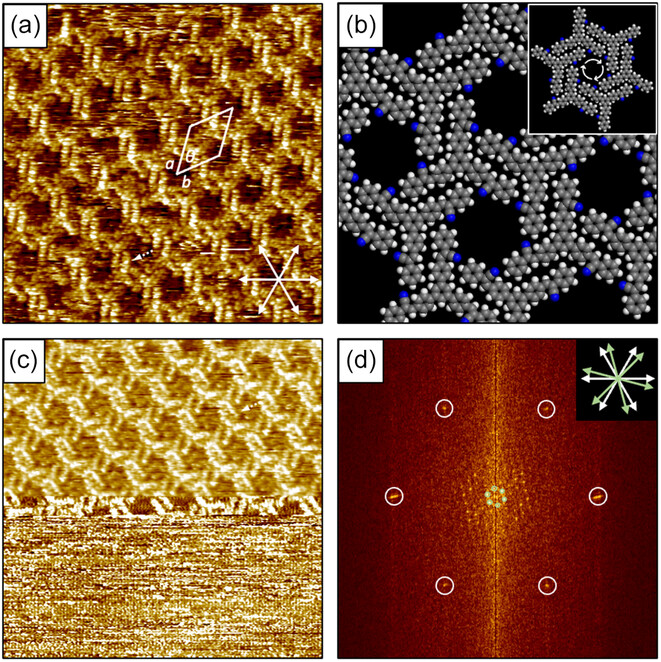 |
| Investigation of the self-assembly of C3-CN-2 characterized by STM at the solid–liquid (HOPG/1-PO) interface. |
A team of researchers at the Center for the Science of Materials Berlin (CSMB) has uncovered a simple molecular design principle that determines whether molecules self-assemble into achiral or chiral structures on a surface. Their findings provide new insights into the fundamental mechanisms of molecular self-assembly and could help guide the design of future functional nanomaterials.
The study, carried out by Dr. Filippo Giovanni Fabozzi, Dr. Nikolai Severin, and Prof. Dr. Stefan Hecht, Director of CSMB, investigates how small changes in molecular geometry influence the organization of molecules confined to a two-dimensional surface.
Using scanning tunneling microscopy (STM), the researchers examined two closely related π-conjugated molecules deposited on graphite. Although both molecules are prochiral – meaning they are achiral in solution but can become chiral when adsorbed on a surface – they assembled into remarkably different structures.
The first molecule formed a dense, closely packed network without any overall handedness. When the researchers extended the molecule’s three peripheral arms, however, the self-assembly process changed dramatically. The modified molecules spontaneously organized into hexagonal rings, producing an ordered nanoporous network with distinct left- and right-handed domains.
“This work demonstrates that a relatively small modification of molecular geometry can fundamentally alter the symmetry of an entire molecular network,” says Dr. Fabozzi. “It provides a rational strategy for designing chiral surfaces from molecular building blocks that are themselves not chiral in solution.”
The work shows that extending the molecular framework is sufficient to drive the transition from an achiral to a chiral two-dimensional supramolecular structure. Such chiral nanoporous networks are attractive platforms for future applications, including host-guest chemistry, molecular recognition, and enantioselective processes, where distinguishing between left- and right-handed molecules is essential.
Beyond these potential applications, the study deepens our understanding of how molecular architecture governs self-assembly at surfaces. By revealing how subtle structural modifications influence collective behavior, the researchers provide a valuable design principle for engineering functional molecular materials from the bottom up.