


Molecular arrows find their target
 |
| Screen capture. © The Odyssey (1997) |
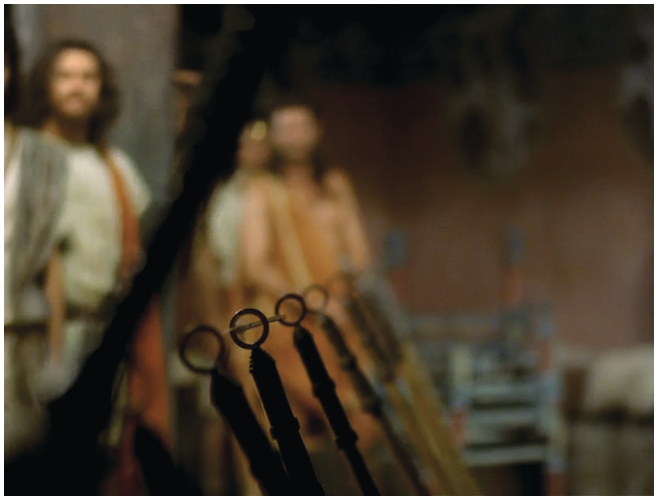
In Homer’s Odyssey, only Odysseus can prove his identity by shooting an arrow through the tiny openings of a row of axe heads – a feat requiring perfect alignment and control. A new study reveals a similar challenge at the molecular scale: some chemical reactions only succeed when molecules approach each other along an extraordinarily precise trajectory.
Chemical bonds form when atoms and molecules collide, but the outcome of these encounters depends on more than simply bringing reactants together. The energy of the collision, the orientation of the molecules, and the exact point of impact all determine whether a new bond can emerge. Controlling these parameters simultaneously has long been one of the great challenges in understanding chemical reactivity.
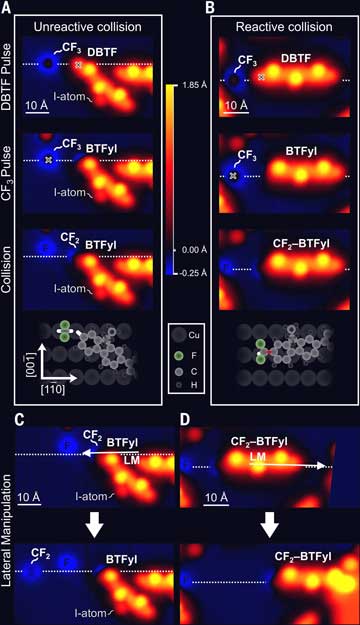
Researchers have now achieved an unprecedented level of control over individual molecular collisions on a metal surface. Using a scanning tunneling microscope, the team positioned, activated, and imaged molecules before and after reaction, turning the microscope into both a tool for manipulation and a window into chemical transformation.
The study involved highly reactive CF2 molecules, created by electron-induced dissociation of surface-bound CF3 groups on a copper (110) surface. These molecular “projectiles” were directed toward organic target molecules, dibromoterfluorenes, whose different orientations on the surface could be precisely determined.
Among the researchers contributing to this work was Prof. Stefan Hecht, director of the Center for the Science of Materials Berlin (CSMB) at Humboldt-Universität zu Berlin.
A narrow path to chemical success
 |
| Directed collisions between the CF2 projectile and BTFyl target. |
The experiment revealed a surprising level of selectivity. Although the target molecules adopted many different orientations on the copper surface, successful bond formation occurred only when the incoming CF2 molecule approached within a tiny angular window of approximately plus or minus 3 degrees.
The reaction behaved like an atomic-scale version of Odysseus’ legendary arrow shot: the molecular projectile had to enter the correct pathway to reach its target. A slightly different angle was enough to prevent the reaction completely.
Theoretical calculations showed that this narrow “cone of reaction” is created by steric effects around the reactive carbon atom. The surrounding atoms act like a molecular obstacle course, allowing only specific approach directions to reach the reaction site.
The copper surface, however, is not merely a passive stage. The researchers found that small displacements of surface atoms could occasionally enable reaction pathways that would otherwise be unfavorable. The metal substrate can therefore actively reshape the possibilities of molecular encounters.
By directly visualizing molecular collision geometries, the study provides a real-space picture of how precisely chemical reactions can be controlled. Understanding these fundamental rules is crucial for designing new surface-based reactions and creating complex nanostructures from molecular building blocks.
Just as an archer must master the exact trajectory of an arrow, chemists are learning how to guide molecular projectiles toward their targets – one atomic connection at a time.