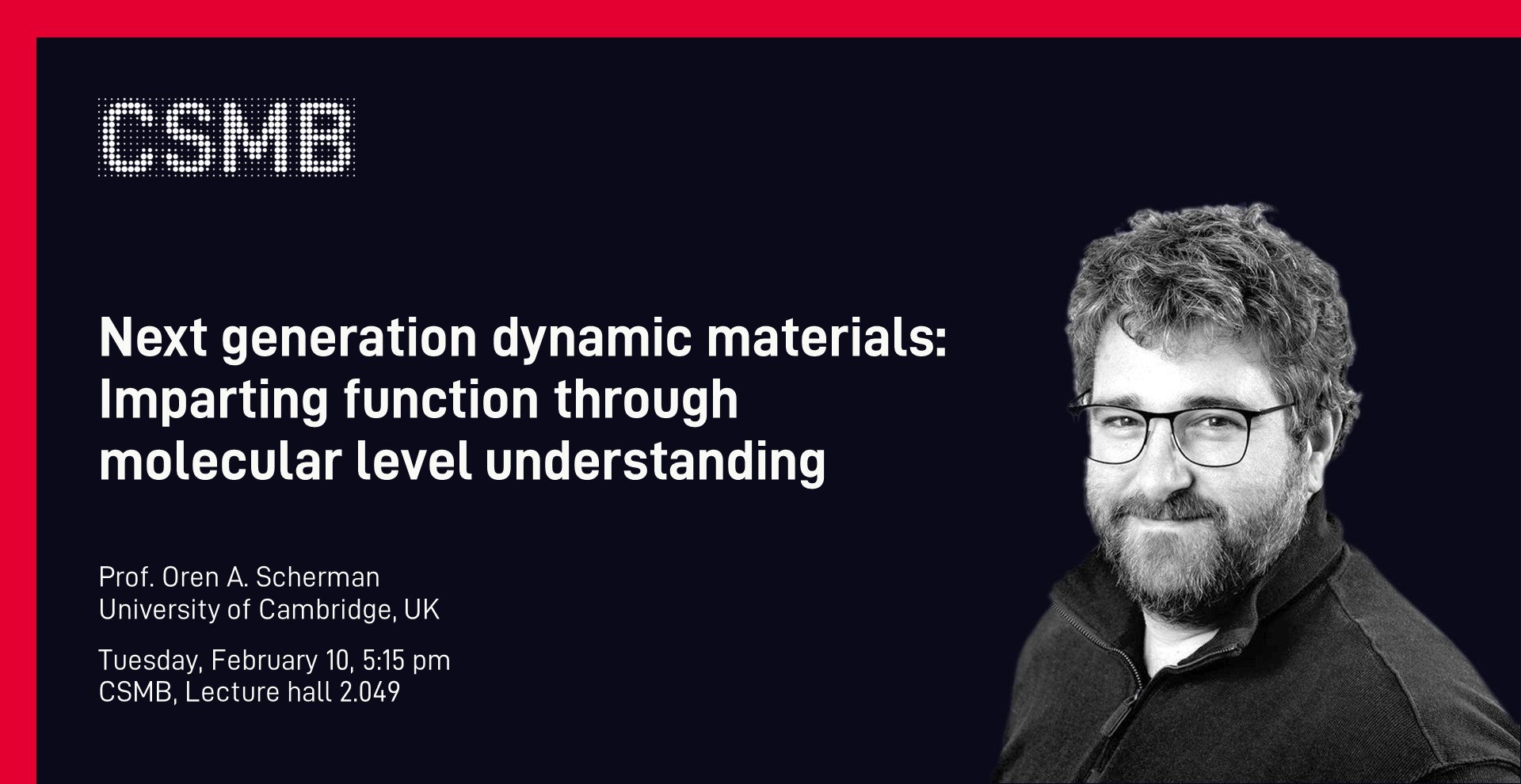
Next generation dynamic materials: Imparting function through molecular level understanding – Prof. Oren Scherman
Professor Oren A. Scherman is a leading figure in supramolecular and polymer chemistry at the Melville Laboratory and the Department of Chemistry, University of Cambridge.
Originally from Norman, Oklahoma, he studied chemistry at Cornell University before completing his PhD at Caltech under Nobel laureate Robert H. Grubbs. He then moved to the Netherlands to work on supramolecular polymers with Professor E.W. Meijer, who presented us his research here a year ago. In 2006, Scherman joined the University of Cambridge, where he has since built an internationally recognized research program. He became Director of the Melville Laboratory in 2013 and was promoted to Full Professor in 2015. His career has been marked by major international recognition in supramolecular chemistry and materials science. Among his highlights is the prestigious Cram Lehn Pedersen Prize, awarded worldwide to outstanding young chemists. He has also received multiple Royal Society of Chemistry honors for exceptional contributions to organic and supramolecular chemistry.
The Scherman Group is known for its interdisciplinary and highly collaborative research culture. Their work focuses on controlling dynamic molecular interactions to design advanced functional materials. Through innovative host–guest chemistry, they engineer responsive polymer networks with real-world applications. In this talk, Professor Scherman will present recent advances in programmable supramolecular materials and their emerging roles in next-generation technologies.
Abstract
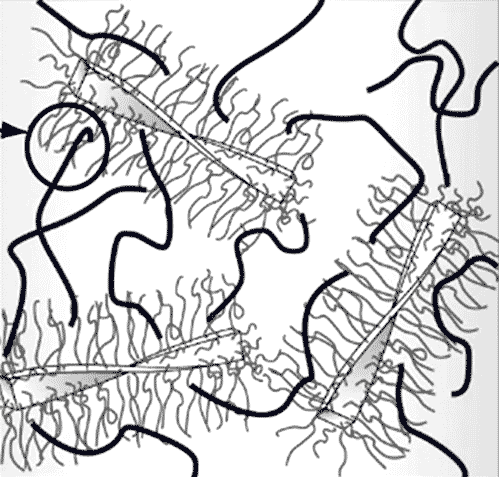 Supramolecular host–guest interactions offer a powerful molecular design strategy to control structure and function across length scales. The Scherman group has pioneered the use of cucurbit[n]urils (CB[n]) – and in particular, CB[8]-mediated ternary complexes – as dynamic, programmable motifs for engineering supramolecular materials. By leveraging the rich host-guest chemistry of CB[8], we have developed a versatile toolbox of orthogonal complexes with tunable binding affinities, association/dissociation kinetics, and interaction modes (π–π, polar–π, charge-transfer). This toolbox allows precise molecular control over dynamic crosslinking events in supramolecular polymer networks (SPNs), enabling bulk properties to be encoded through molecular recognition.
Through systematic study of CB[8]-mediated crosslinks and their dynamics, we have demonstrated how subtle modifications in guest structure and interaction type can profoundly influence viscoelastic behaviour, toughness, and self-healing. For example, slowdissociating CB[8] polar–π complexes enabled the fabrication of glass-like SPNs with high compressive strength and rapid self-recovery (Nat. Mater., 2022), while strong yet dynamic π–π complexes formed the basis of highly stretchable, tough elastomers for strain sensing (Adv. Mater., 2017). Most recently, we have introduced conductive SPNs with simultaneous ionic and electronic transport, paired with tissue-like mechanical properties, enabling seamless integration with the human body (Adv. Mater., 2023).
Our ongoing efforts focus on the molecular engineering of CB[n]-based host–guest complexes to program and augment bulk material behaviour. This molecular-level control over dissociation dynamics, network architecture, and reversible binding continues to unlock new functionalities in soft robotics, wearable electronics, and biomedical interfaces. We anticipate that further exploration of these supramolecular structure–property relationships will provide a blueprint for designing responsive, high-performance materials from the molecular scale upward.
Please, let us know if you plan to attend by registering here:
No entry fee.
During the event, photo and video recordings might be made. The material will be used exclusively for the purpose of public relations at CSMB & HU Berlin.