

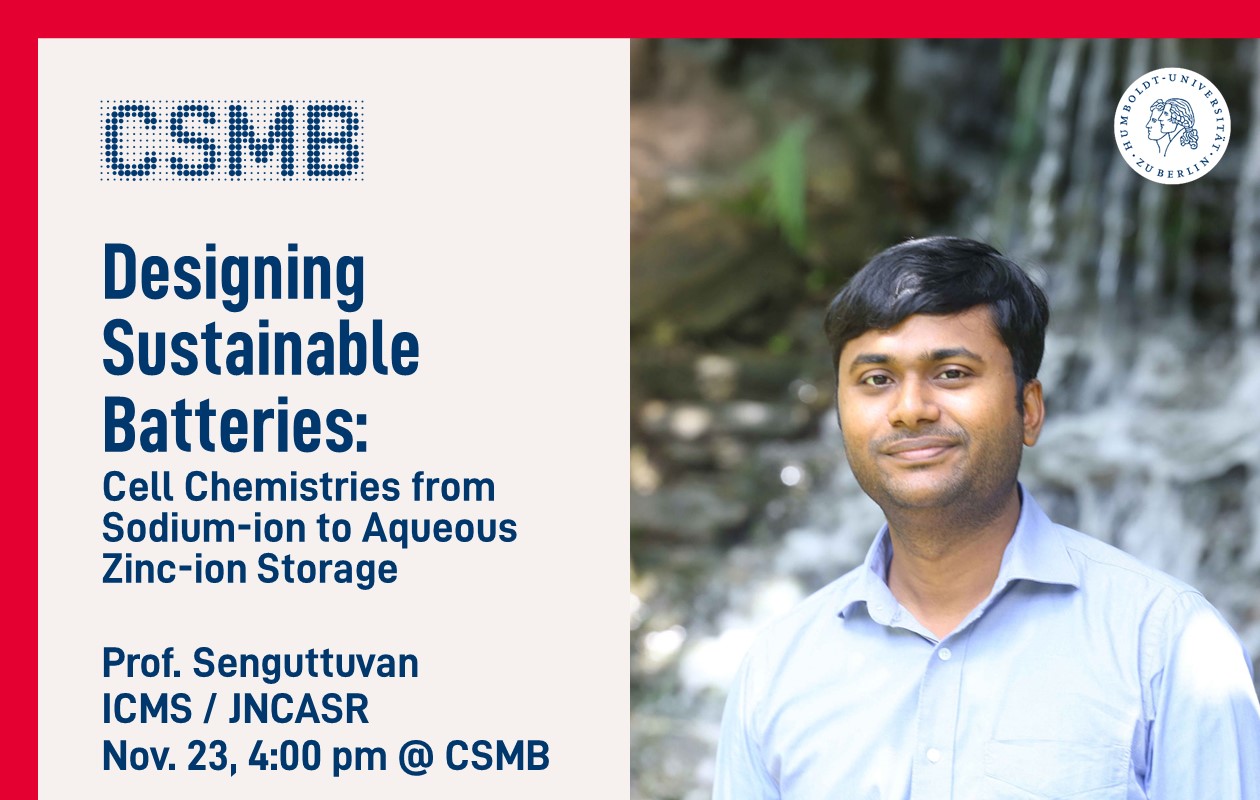
Designing Sustainable Batteries
Prof. Premkumar Senguttuvan is an Associate Professor at the Jawaharlal Nehru Centre for Advanced Scientific Research (JNCASR), Bengaluru, India, where he leads the Energy Storage and Conversion Laboratory. His research focuses on the design of advanced materials and electrochemical systems for next-generation energy storage, with particular emphasis on sodium-ion, zinc-ion, and multivalent batteries. His expertise spans electrode materials, electrolyte engineering, operando characterization, and the development of practical battery technologies.
His group combines materials synthesis, advanced structural characterization and electrochemistry approaches to understand ion transport, redox chemistry, and interfacial phenomena in batteries.
Prof. Senguttuvan has authored over 40 peer-reviewed publications in leading journals, secured competitive national and international research funding, and received several prestigious recognitions, including the Alexander von Humboldt Research Fellowship for Experienced Researchers, Member of Editorial Advisory Board – Chemistry of Materials (2026-), JACS Au Early Career Advisory Board membership, the IGSTC PECFAR Award (2025), the JMCA Emerging Investigators Award (2023), and the DAE-BRNS Young Scientist’s Research Award. His research aims to bridge fundamental materials chemistry with scalable, sustainable energy storage technologies for electric mobility and grid-scale applications.
Abstract
Designing Sustainable Batteries:
Cell Chemistries from Sodium-ion to Aqueous Zinc-ion Storage
 The growing demand for safe, cost-effective, and sustainable energy storage has stimulated increasing interest in alternative battery technologies beyond conventional lithium-ion batteries. Sodium-ion batteries (SIBs) and aqueous zinc-ion batteries (ZIBs) offer promising opportunities owing to the abundance, accessibility, and sustainability of their constituent materials. However, challenges related to electrode stability, ion transport, interfacial chemistry, and long-term cycling performance continue to limit their practical applications. Addressing these challenges requires a fundamental understanding of the underlying electrochemical processes and the development of rational materials and electrolyte design strategies.
In this talk, we will discuss how electrode and electrolyte engineering can address these challenges and advance the performance of sodium- and zinc-based batteries. For sodium-ion batteries, we will explore the role of site-specific chemical substitution and structural design in stabilizing NASICON-type niobium phosphate frameworks, enabling rapid Na⁺ transport, reversible redox reactions, and exceptional cycling stability. For aqueous zinc-ion batteries, we will highlight how electrolyte engineering through organic co-solvents and functional additives can regulate electrode–electrolyte interfacial chemistry, suppress zinc dendrite formation, and mitigate cathode dissolution. We will also discuss how advanced characterization techniques provide insights into structural evolution and interfacial mechanisms. Together, these perspectives illustrate the importance of understanding and controlling both electrode structures and electrolyte chemistry in designing safer, more durable, and high-performance batteries for sustainable energy storage.
Please, let us know if you plan to attend by registering here:
No entry fee.
During the event, photo and video recordings might be made. The material will be used exclusively for the purpose of public relations at CSMB & HU Berlin.