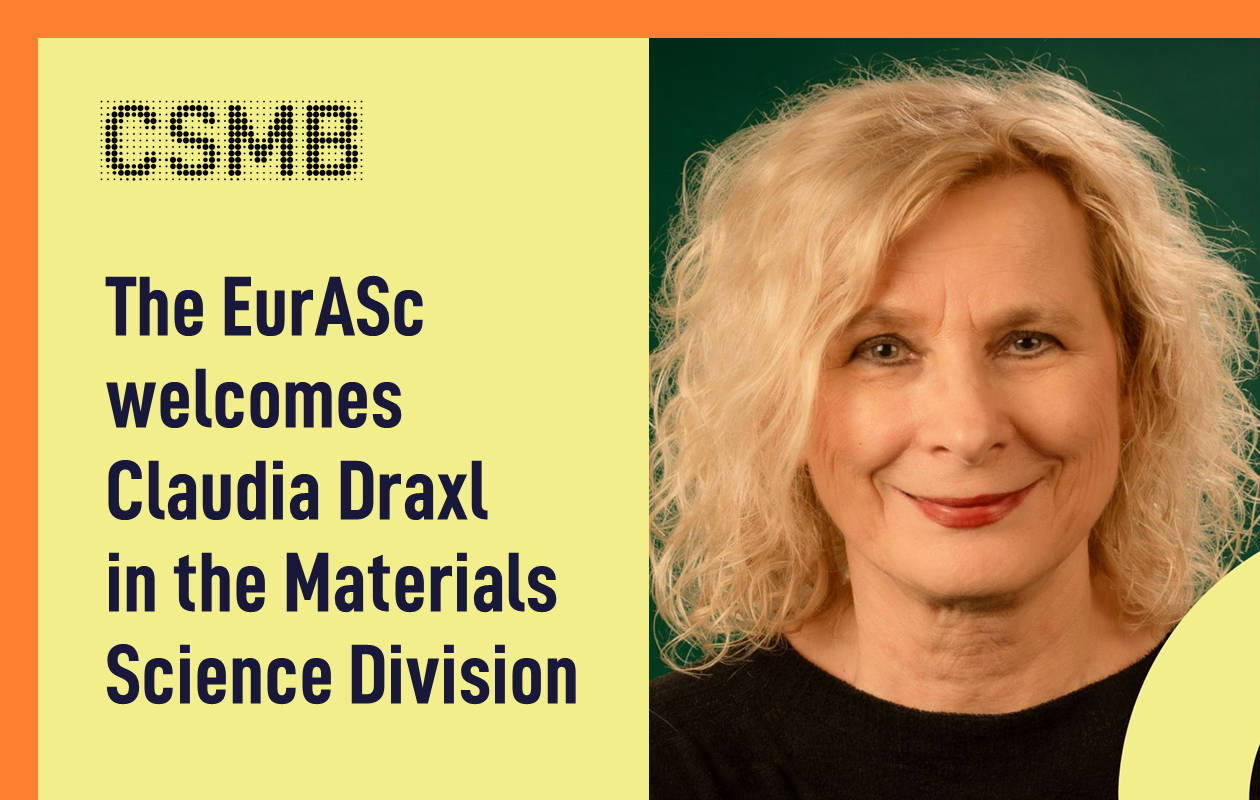
We are proud to announce that the European Academy of Sciences (EurASc) welcomes Prof. Claudia Draxl as a new Member of the Academy in the Materials Science Division, recognizing her pioneering contributions to theoretical solid-state physics, computational materials science, and materials informatics.
Prof. Draxl’s research has advanced the understanding of the electronic, optical, and excitonic properties of materials through first-principles methods while playing a transformative role in establishing FAIR data principles and artificial intelligence as key drivers of next-generation materials discovery.
Currently Professor of Theoretical Solid-State Physics at Humboldt-Universität zu Berlin, Prof. Draxl is the spokesperson of the NOMAD Centre of Excellence and the FAIRmat consortium, two landmark European initiatives accelerating data-driven materials research. With an h-index of 77, more than 27,000 citations, around 500 invited lectures, and extensive leadership in major European research infrastructures, she has become one of the world’s leading figures in computational materials science.
Her scientific excellence has been recognized through numerous prestigious honours, including election to the German National Academy of Sciences Leopoldina, Fellowship of the American Physical Society, Max Planck Fellowships, and an Honorary Doctorate from Uppsala University. Beyond her outstanding research, Prof. Draxl has made lasting contributions to scientific leadership, international collaboration, open science, and the training of future generations of materials scientists.
The CSMB congratulates our member Prof. Claudia Draxl on this well-deserved recognition, and we wish her every success in her new role!
About the European Academy of SciencesThe mission of EurASc is to promote excellence in scientific research and technological innovation, fostering fundamental and interdisciplinary science as the foundation of progress and societal development. |
Further Information
Original LinkedIn Post by EurASc:
https://www.linkedin.com/posts/european-academy-of-sciences-b938b010a_eurasc-newmember-materialsscience-activity-7478450937058119680-gSFl
European Academy of Sciences: eurasc.eu/