

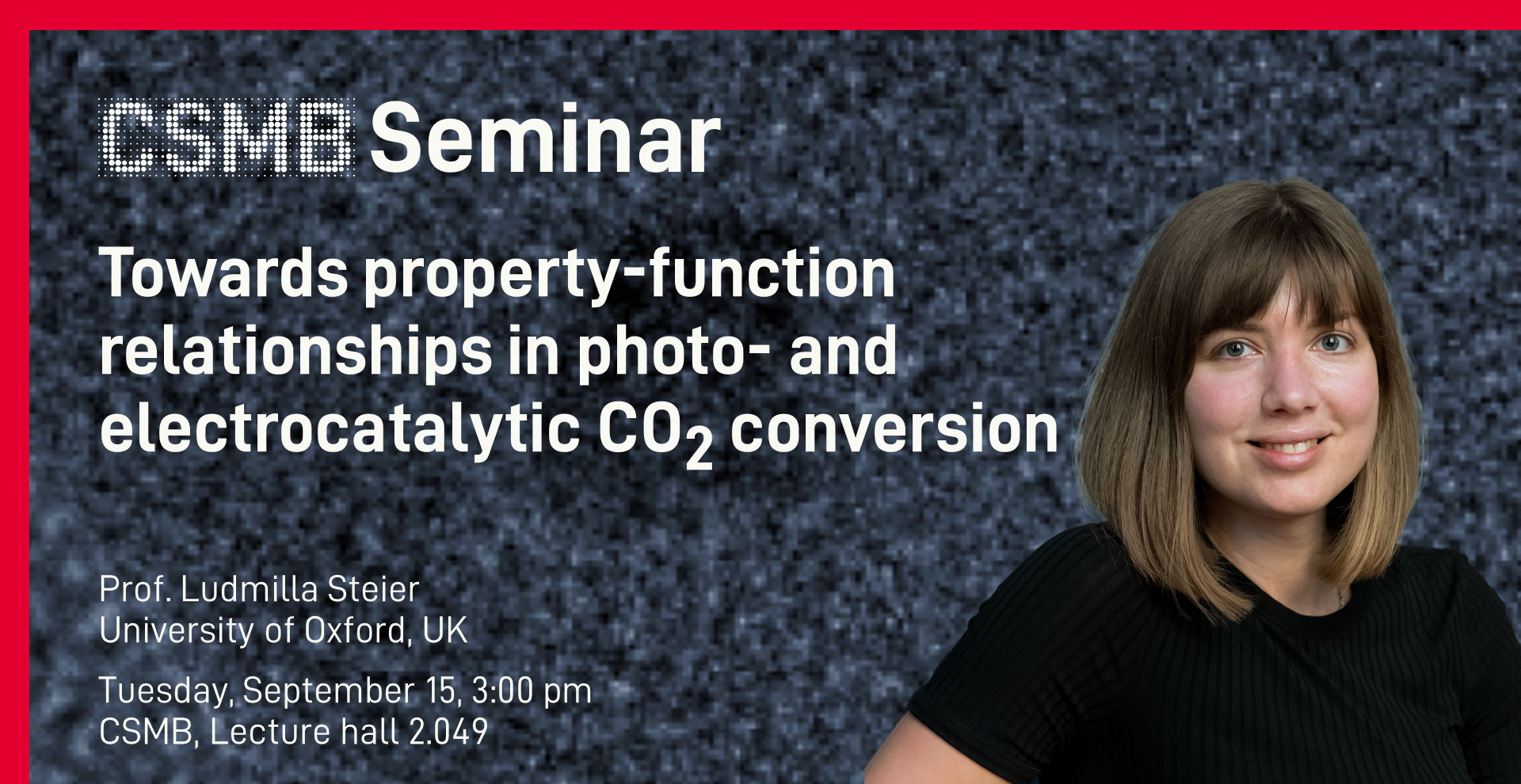
Towards property-functionrelationships in photo- and electrocatalytic CO2 conversion
Prof. Ludmilla Steier is an Associate Professor of Inorganic Chemistry and the Goodenough Tutorial Fellow at Saint Catherine’s College. Already during her undergraduate studies she developed an interest in electrochemistry and semiconductor physics driving her to pursue her M.Sc. final project on dye-sensitized solar cells in the group of Prof. Michael Grätzel at the École Polytechnique Fédérale de Lausanne (EPFL, Switzerland). Staying in the same group, she worked on oxide thin film photoelectrodes applied in photoelectrochemical water splitting and perovskite solar cells during her Ph.D. degree which she obtained in 2016.
Prof. Steier joined the group of Prof. James Durrant at Imperial College London to study photochemical and photophysical processes in semiconductors using time-resolved spectroscopy and shortly after was awarded the Marie Skłodowska-Curie Fellowship (2017-2019). She began her independent research career as Imperial College Research Fellow (2019-2021) before moving to Oxford in October 2021.
Prof. Steier was awarded the 2023 Materials Chemistry Early Career Prize from the Royal Society of Chemistry for seminal contributions to the understanding of defect chemistry in semiconducting materials and interfacial energetics in photocatalytic and photovoltaic devices.
Her group’s research at Oxford aims at the design of atomically defined photo- and electrocatalysts that convert CO2, water and other “waste products” to energy-rich fuels and chemicals with high conversion efficiency, selectivity and long operational stability which they pursue thanks to funding by the UKRI (for the ERC Starting Grant), SCG Chemicals, the Royal Society, the John Fell Fund and the University of Oxford.
Abstract:
Catalyst design for the reduction of CO2 to valuable fuels needs property-function relationships to identify more generalised material design guidelines. A large body of work has been developed studying defect chemistry, especially oxygen vacancy chemistry, in oxide systems for the water oxidation reaction, since these surfaces are typically unprotected, offering the direct investigation of the semiconductor-liquid junction in a photoanode.[1, 2] Whereas studies on electrodes that do not change in morphology can reliably link defect-related recombination to the photoconversion yields, I will discuss that such trends need to be assessed with more rigour if the morphology and hence surface area vary significantly. In addition, it is important to develop metrics to quantify the catalytically active area or sites. This is especially important for nanoparticulate or microporous systems currently employed in photocatalysis. Our latest works aim at establishing such metrics studying the CO2 photo-hydrogenation reaction,[3-6] as well as the electrochemical CO2 reduction.[7]
[1] L. Steier et al., Understanding the Role of Underlayers and Overlayers in Thin Film Hematite Photoanodes. Advanced Functional Materials 24, 7681–7688 (2014).
[2] S. Corby, R. R. Rao, L. Steier, J. R. Durrant, The kinetics of metal oxide photoanodes from charge generation to catalysis. Nature Reviews Materials 6, 1136–1155 (2021).
[3] F. Moruzzi et al., Solution-processable polymers of intrinsic microporosity for gas-phase carbon dioxide photoreduction. Nature Communications 14, 3443 (2023).
[4] D. Bhattacharyya et al., Decoupling Size and Electronic Effects in Doped SrTiO3 Photocatalysts Through Surface Area–Normalized CO2 Hydrogenation Rates. Advanced Functional Materials 36, e11923 (2026).
[5] B. Shani, F. Lamaina, L. Li, L. Steier, The Effect of SrTiO3 Sol-Gel Synthesis Temperature on Reaction Yields in CO2 Photohydrogenation. (to be submitted).
[6] B. Shani et al., How normalisation of photocatalytic yields stirs our conclusions. (to be submitted).
[7] Y. Zhou et al., Revisiting Active Site Quantification in CO2 Electroreduction: The Case for CO Displacement. ACS Energy Letters 10, 4324–4331 (2025).
Please, let us know if you plan to attend by registering here:
No entry fee.
During the event, photo and video recordings might be made. The material will be used exclusively for the purpose of public relations at CSMB & HU Berlin.