
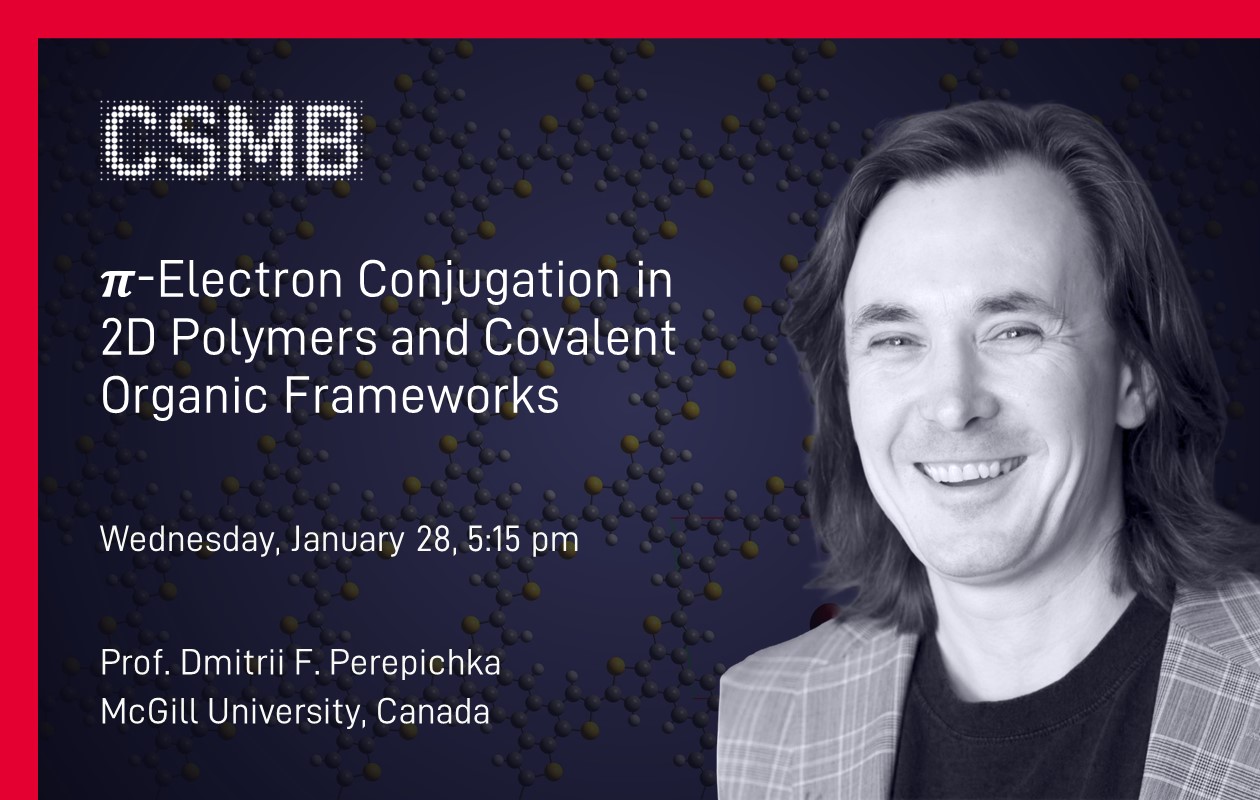
𝝅-Electron Conjugation in 2D Polymers and Covalent Organic Frameworks – Prof. Dima Perepichka
Dmitrii “Dima” F. Perepichka is Professor in Chemistry at McGill University. His research interest are primarily in the area of organic electronics. He has contributed in the understanding of structural electronics effects of organic conjugated materials at molecular, supramolecular, and macromolecular levels via the study of small molecules, supramolecular (co-)assemblies, polymers, covalent organic frameworks, and on-surface assemblies/polymers.
Research Description
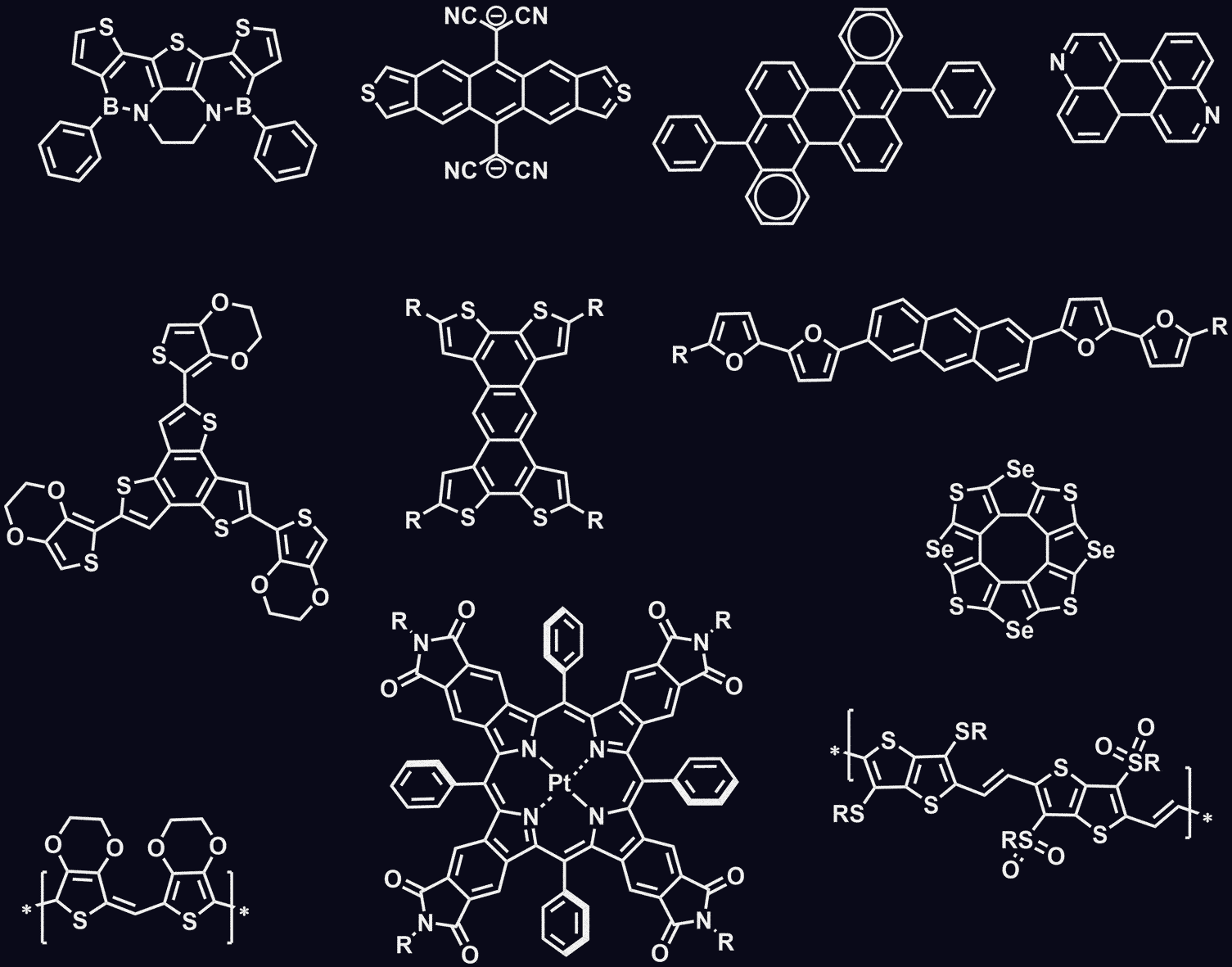
The main research theme in his group is discovering new electronic properties in organic and hybrid materials. En route to this goal, they are engaged in design and synthesis of novel pi-conjugated molecules and polymers, and study of their optical and electronic behavior, in solution, in thin films and crystals, and in semiconducting devices. Organic synthesis accounts for about 70% of our research activity, but the essence of these efforts is “making” novel properties, not merely new molecules. Thus, the new members of the group should also expect to develop expertise in one (or more) of the following: quantum-chemical calculations; supramolecular chemistry; photophysical and electrochemical measurements; semiconducting device fabrication; thin films and surface characterization techniques, scanning probe microscopy.
Abstract
π-Electron conjugation in graphene gives rise to unusual electronic properties including massless charge carriers. In principle, some of these properties could be harvested in organic two-dimensional (2D) p-conjugated polymers. Currently, there are two general approaches to synthesize such materials: surface-tempated polymerization and dynamic solution polymerization. The former is typically performed on metal surface in ultra-high vacuum and produces monolayers of 2D polymers.
The latter relies on reversible reaction to reach the (thermodynamically stable) ordered states, and produces 2D polymers as stacked multilayer solids, a.k.a. covalent organic frameworks (COFs). I will present our work towards 2D polymers using both of these approaches, discussing the challenges of the synthesis and characterization, and focusing on the design of π-electron functionality in such materials. I will discuss how the topology of the building blocks and the linkers affect electron delocalization and properties in these materials, including electrical conductivity, luminescence, and stimuli-responsive behavior.
Please, let us know if you plan to attend by registering here:
No entry fee.
During the event, photo and video recordings might be made. The material will be used exclusively for the purpose of public relations at CSMB & HU Berlin.