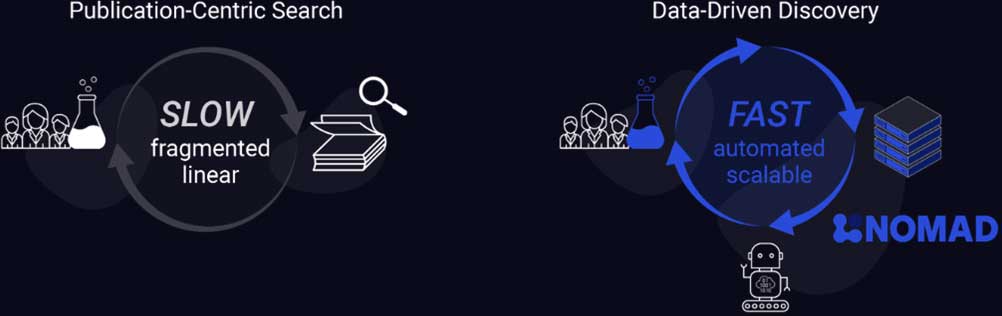
The FAIRmat consortium of the National Research Data Infrastructure (NFDI) has developed a new web-based application, the Catalysis App, for managing standardized experimental catalysis data. This work is now reported in the journal Nature Catalysis. The Catalysis App allows researchers to share, explore, and analyze data and provides a foundation for artificial-intelligence-driven discovery of more efficient and sustainable catalysts. The work was carried out within FAIRmat at the Center for the Science of Materials Berlin (CSMB) at Humboldt-Universität zu Berlin, with major contributions from Dr. Julia Schumann and scientific leadership by FAIRmat Principal Investigator Dr. Annette Trunschke. The collaboration brings together researchers from the Humboldt-Universität zu Berlin, the Fritz Haber Institute of the Max Planck Society, and the Helmholtz-Zentrum Berlin.
Why does catalysis research need better data?
Catalysis plays a central role in the chemical industry and is essential for enabling more sustainable technologies, including processes that support the transition to low-carbon economy. Exploring and developing new catalysts is an important area of research in chemistry and materials science. However, searching for new catalysts is often costly and labor-intensive. Modern data science could accelerate the discovery and optimization of new and improved catalysts. Therefore, archiving and providing experimental research data is of particular interest. Currently, the lack of machine-readable experimental data impedes data-driven discoveries in catalysis research. Although there are already repositories for catalysis data, they are not sufficiently structured or equipped with metadata to be easily usable by AI.
“Catalysts are essential for making chemical processes more efficient and environmentally friendly. Modern data science and artificial intelligence could help discover improved catalysts much faster, but research data is often difficult to use because it is not stored in a standardized way,” says Dr. Annette Trunschke, FAIRmat principal investigator. “We developed a catalysis app for the NOMAD database that allows researchers to store and share their data in a consistent format. This makes it easier to compare results and enables future AI-driven catalyst development. The platform will become more powerful as more researchers contribute their data.”
Handling large amounts of research data
Digital research data forms an essential foundation for scientific work. Whether in the laboratory or on the computer, vast amounts of data are generated in science. Modern research institutions therefore need effective concepts for managing their data to ensure the quality, traceability, and long-term reusability of data in accordance with the FAIR principles. FAIR stands for Findability, Accessibility, Interoperability, and Reusability of digital assets.
The primary goal of research data management is to promote transparency and traceability in research, and to avoid duplication of work through the reuse of research data. Thus, the management of research data is a central component of good scientific practice. Within FAIRmat, these principles are implemented through domain-specific tools and services in the NOMAD ecosystem.
“Catalysts are essential for making chemical processes more efficient and environmentally friendly. Modern data science and artificial intelligence could help discover improved catalysts much faster, but research data is often difficult to use because it is not stored in a standardized way,” says Dr. Annette Trunschke, FAIRmat principal investigator. “We developed a catalysis app for the NOMAD database that allows researchers to store and share their data in a consistent format. This makes it easier to compare results and enables future AI-driven catalyst development. The platform will become more powerful as more researchers contribute their data.”
New Catalysis App within NOMAD
The open-source, web-based NOMAD ecosystem is ideally suited to setting up a domain-specific application for standardized experimental catalysis data. Within NOMAD, the team has created an AI-ready Catalysis App that will ultimately enable FAIR data in catalysis.
The Catalysis App is now ready to use.
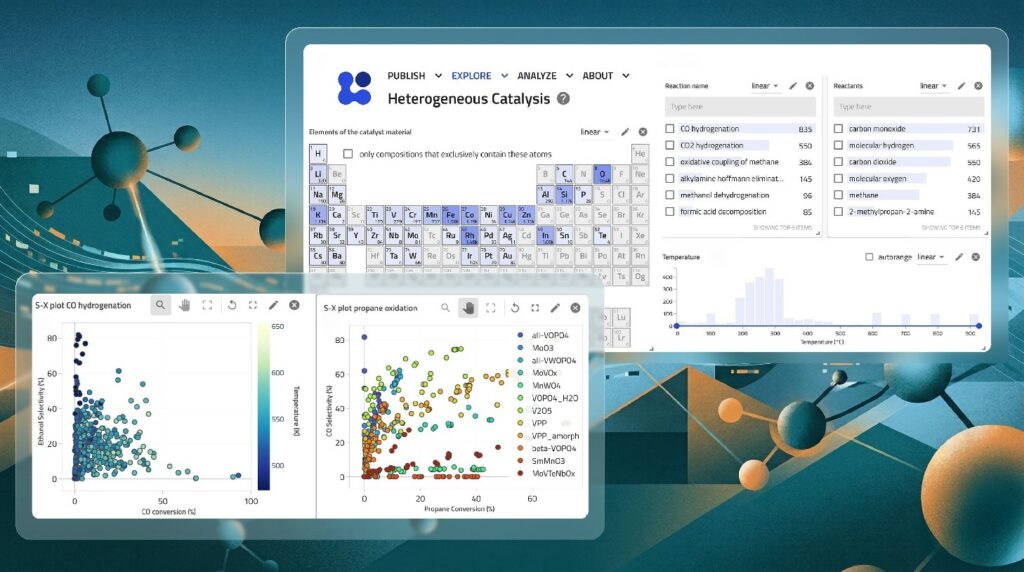
The new Catalysis App within NOMAD provides a standardized way to collect, share, and analyze experimental catalysis data. It enables researchers to work with structured, comparable, and machine-readable data through an intuitive graphical user interface (GUI) or programmatically using application programming interface (API). The user interface has been designed so that information can be retrieved from different perspectives. For example, it is possible to ask which chemical elements or compositions are good catalysts for a desired chemical reaction. Alternatively, it is possible to ask which products are formed from specific starting compounds using which catalyst. In addition, many other parameters can be filtered, such as the synthesis method, the form of the catalyst, such as supported catalyst, shaped body, or thin film, or the reaction conditions. This allows users to search only for high-pressure reactions or only for low-temperature applications.
A key advantage of this app is its data visualization feature. Some plots have been predefined in the app, but users can also design their own graphical representations.
Data can be uploaded both manually and automatically via the API. The authors developed schemas, i.e., data structures, for typical datasets in catalysis. Furthermore, they designed Excel spreadsheet templates that can be directly parsed and allow users to enter their data in a format that is familiar to most researchers.
Example data for frequently studied catalytic reactions are available in the app. The authors would like to thank the numerous catalysis researchers for their support in creating these.
Outlook and call for participation
The Catalysis App supports the exchange of catalysis data and lays a solid groundwork for AI-driven analytics. Yet, the value of a digital tool such as the Catalysis App increases significantly with the volume, diversity and quality of the data it hosts. Hence, the authors encourage the community to explore the tool, test its capabilities, and build upon it. They also welcome constructive feedback to help develop the application further and ensure that it continues to meet the evolving needs of researchers.
More about NOMAD
“NOMAD” stands for “Novel Materials Discovery” and is a data infrastructure for research data management. It offers a free, open-source web interface to manage and share data from experimental and computational materials science. Since its start in 2014 as a repository for computational data, NOMAD has grown steadily and is now developed by the FAIRmat consortium, part of the National Research Data Infrastructure (NFDI) and coordinated at Humboldt-Universität zu Berlin.
Contact
|
|
Article
Julia Schumann, Hampus Näsström, Michael Götte, Lauri Himanen, Abdulrhman Moshantaf, Markus Scheidgen, José A. Márquez, Claudia Draxl, Annette Trunschke
Enabling open and FAIR catalysis data with standardized data structures
Nature Catalysis, 2026, accepted
DOI: 10.1038/s41929-026-01508-9


Dr. Julia Schumann
Dr. Annette Trunschke